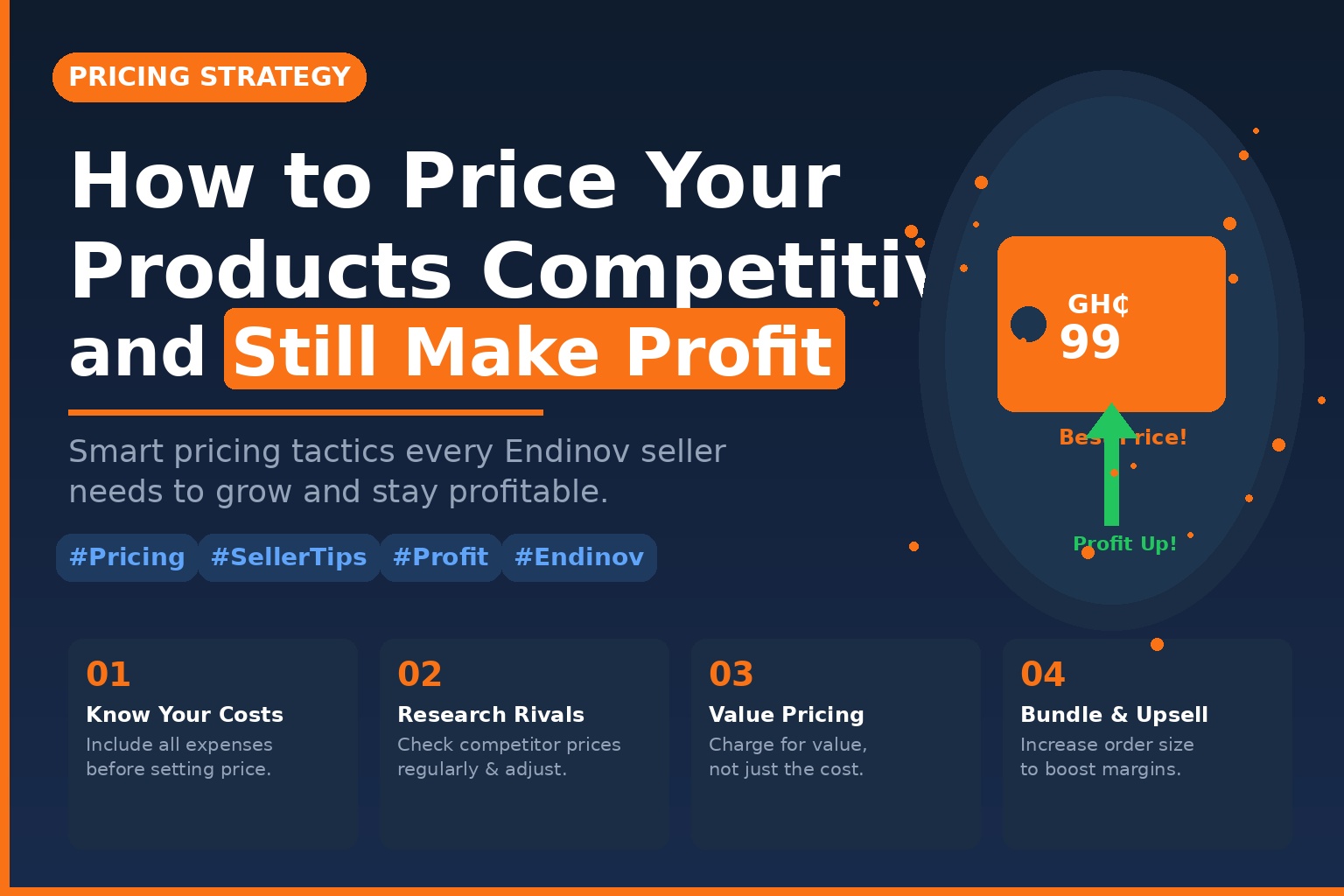



How to Price Your Products Competitively and Still
Make Profit
Pricing is one of the most powerful decisions in your business. Set it too high, and customers walk away. Set
it too low, and you struggle to make profit.
The goal is simple: stay competitive while still making sustainable profit. On marketplaces like Endinov,
where customers compare options quickly, smart pricing can be the difference between slow sales and
consistent growth.
Here’s how to get it right.
- Understand Your Total Cost First
Before you set any price, you must know how much your product truly costs.
Include:
Cost of production or purchase
Shipping and packaging
Marketplace or transaction fees
Marketing or advertising costs
Any hidden operational expenses
A common mistake sellers make is only pricing based on purchase cost. That leads to “fake profit” that
disappears later.
Formula:
Total Cost = Product Cost + Expenses - Define Your Profit Margin
Once you know your total cost, decide how much profit you want to make per sale.
Example:
Total cost: GHS 50
Desired profit: GHS 20
Selling price: GHS 70
Your pricing should always include a clear profit margin, not guesswork. - Research Your Competitors
Check what similar sellers are charging on Endinov and other platforms.
Ask yourself:
What is the average market price?
Are competitors targeting budget or premium buyers?
What value do they offer at that price?
You don’t always need to be the cheapest—you need to be competitive and valuable.
Sometimes customers pay more for:
Better packaging
Faster delivery
Stronger branding
Better customer service - Use Psychological Pricing
Small changes in pricing can influence buyer behavior.
Examples:
GHS 100 instead of GHS 105
GHS 99.99 instead of GHS 100
Bundle pricing (Buy 2, save 10%)
These pricing strategies make products feel more affordable and increase conversion rates. - Offer Value, Not Just Low Prices
Competing only on price is risky. Someone will always go cheaper.
Instead, increase perceived value:
Add bonuses (e.g., free gift, discount on next order)
Improve product presentation
Offer better customer support
Provide faster delivery options
Customers are willing to pay more when they feel they’re getting more. - Test and Adjust Your Prices
Pricing is not fixed forever. It should evolve based on data.
Monitor:
Sales volume
Customer feedback
Conversion rate
Profit per product
If sales are low, you may need to adjust price or improve value. If sales are high but profit is low, you may be
underpricing. - Use Tiered Pricing (Optional but Powerful)
You can offer different versions of the same product:
Basic version (lower price)
Standard version (mid-range)
Premium version (higher price with extras)
This helps you attract different types of buyers while maximizing profit.
Final Thoughts
Smart pricing is not about being the cheapest—it’s about being strategic.
When you understand your costs, study the market, and position your product correctly, you can stay
competitive and still make strong profit.
On Endinov, success comes to sellers who think long-term, not just those chasing quick sales.
Price smart. Sell confidently. Grow sustainably.
Add comment